Move from AI experiments
to AI-enabled operations.
A strategic deployment model that helps organizations prepare their people, workflows, systems, data, governance, costs, and growth strategy for successful AI transformation. Eight pillars. Five maturity stages. Built to scale.
AI adoption is no longer about whether a team can use a chatbot. The real question is whether the organization can reconfigure how work gets done when AI agents, automations, knowledge systems, and human decision-makers begin operating together.
The AI Forward Framework helps organizations move from scattered experimentation to practical, governed, measurable AI deployment. It connects the strategic, operational, technical, data, governance, cost, and growth layers required to make a business AI ready.
AI deployment success hinges on navigating ongoing operating system transitions. Team enablement now requires more adaptive thinking. To move forward, organizations need more than tools — they need adaptive teams, modern workflows, clean data, governed agent execution, cost awareness, and a strategy for the new AI layer that's changing how users search and get answers.
Some users may never Google you again. That's just one of many shifts to consider as you pivot.
How the framework fits with the
Agent Operating System.
Business context grounds the system. The framework aligns people and infrastructure. The Agent OS routes the work. The tooling layer executes.
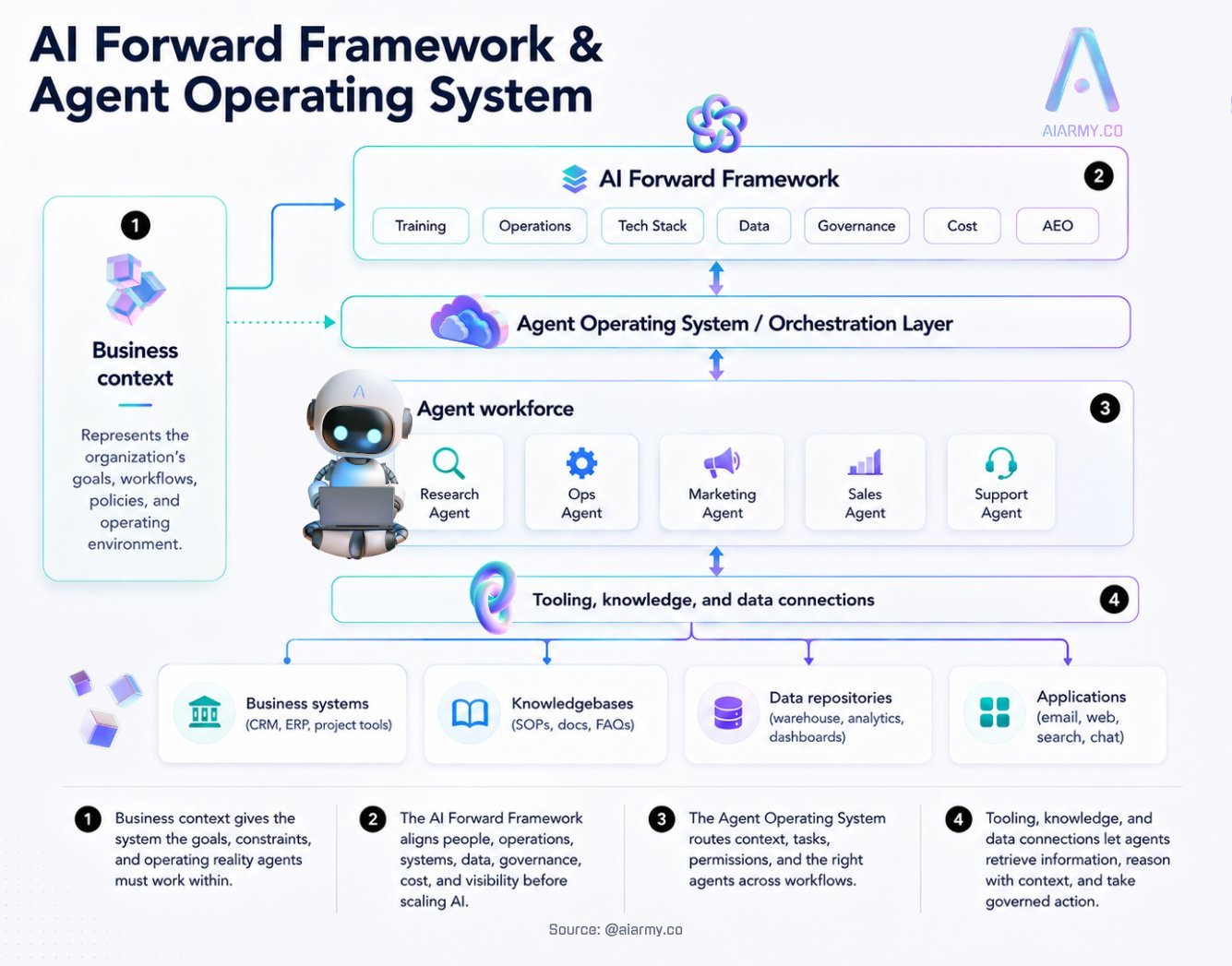
// Architecture · AI Forward Framework · aiarmy.co
Eight pillars of AI Forward deployment.
Each pillar can stand alone — but they compound when implemented together. Tap any pillar to dive deep.
Mindset & Adaptive Learning
Build the culture, literacy, and feedback loops that let teams keep up with shifting AI capability.
Operations Reconfiguration
Redesign workflows around the work, not around old processes. Separate human-only from AI-assisted from automatable.
Agent OS + Orchestration
The connective tissue between humans, agents, systems, and tools. Where AI work becomes structured and governed.
Tech Stack Modernization
Get systems connected, source-of-truth defined, and integration pathways ready for agent access.
Data Quality + Knowledgebases
Clean, current, permissioned, structured. Agents are only as useful as the knowledge they can trust.
Governance & Security
Access, approval, audit, and incident response — built into deployment from day one, not bolted on.
LLM Cost Estimation
Tokens, models, agent loops, retries — understand the economics before scaling workflows.
AEO: AI Answer Visibility
Show up — accurately — when AI engines answer buyer questions. The new growth channel.
AI Forward Mindset & Adaptive Learning Environment
AI transformation starts with how the organization learns. Companies that succeed with AI don't treat it as a one-time software rollout — they build a culture that can continuously evaluate new capabilities, test practical workflows, and help teams adapt without losing control or quality.
An AI-forward mindset means leaders and teams understand that AI isn't just another tool. It changes how information is accessed, how work is delegated, how decisions are supported, and how teams coordinate across functions.
The static training session is dead. AI capability shifts in weeks, not years — and the organizations winning are the ones whose people can keep improving how they use AI while leadership maintains visibility, security, and strategic direction.
Why it matters
AI capability changes quickly. Organizations need an adaptive learning environment where employees can keep improving how they use AI while leadership maintains visibility, security, and strategic direction.
What this pillar includes
- Executive alignment around AI goals, risks, and business priorities
- Role-based AI literacy across leadership, operations, marketing, sales, service, and technical teams
- Clear internal language for agents, automations, copilots, workflows, and governance
- Safe experimentation environments where teams can test AI use cases before scaling
- Practical training focused on real work, not abstract AI hype
- Internal AI champions who help translate lessons across departments
- Feedback loops for improving prompts, workflows, policies, and outcomes over time
Deployment success signals
- Teams know when to use AI, when not to, and when to escalate to a human
- Employees can describe their highest-value AI use cases in plain business terms
- Leadership has a shared view of AI priorities and risk boundaries
- AI training is connected to actual workflows, tools, and measurable outcomes
- New AI capabilities can be evaluated without causing organizational chaos
AI ARMY helps teams build practical AI literacy, identify high-value workflows, create internal adoption plans, and develop the operating habits required for responsible AI deployment.
Reconfiguring Operations for Agent Automation
AI deployment works best when operations are redesigned around the work itself — not simply layered on top of old processes. Many organizations try to add AI into broken, manual, fragmented workflows. That usually leads to inconsistent results.
Before agents and automations can reliably help, the business needs to understand where work begins, what decisions are made, what systems are involved, what data is required, and where human judgment must remain in the loop.
This pillar focuses on reconfiguring operations so AI agents can assist, automate, route, summarize, draft, analyze, and execute — with the right boundaries. The goal isn't more automation. It's governed execution paths that turn vague automation ideas into reliable systems.
Why it matters
Agents are only as effective as the workflows they're placed inside. If the process is unclear, the agent has to guess. If the data is scattered, the agent lacks context. If approvals are undefined, the system becomes risky or too constrained to be useful.
What this pillar includes
- Workflow mapping across sales, marketing, operations, support, finance, admin, and delivery
- Identification of repetitive, high-friction, high-volume tasks
- Separation of tasks into human-only, AI-assisted, review-first, and automatable categories
- Definition of approval gates for sensitive or external-facing actions
- Process redesign for agent-supported work
- Trigger-based automation planning
- Human-in-the-loop review structures
- Measurement of time savings, quality improvement, and operational bottlenecks
Deployment success signals
- Core workflows are mapped and prioritized by business impact
- Teams know which workflows are ready for AI assistance and which need cleanup first
- Automations include clear triggers, inputs, outputs, owners, and approval rules
- AI-supported work reduces friction without removing necessary human judgment
- Leadership can see where AI is creating operational leverage
AI ARMY helps organizations audit workflows, identify automation opportunities, redesign processes for agent support, and build practical deployment roadmaps that connect AI usage to business outcomes.
Agent Operating System + The Orchestration Layer
As AI usage grows, organizations need more than individual tools. They need an operating layer that coordinates agents, workflows, data, permissions, approvals, and execution traces across the business.
An Agent Operating System is the connective tissue between humans, AI agents, business systems, knowledgebases, and external tools. It helps teams move from disconnected AI experiments to coordinated, governed, repeatable AI operations.
The orchestration layer determines which agent or tool should handle a task, what context it can access, what actions it's allowed to take, what approvals are required, and how the work is logged. Without orchestration, AI adoption becomes fragmented — different tools, different prompts, different data, no shared visibility.
Why it matters
Without orchestration, AI adoption becomes fragmented. Teams may use different tools, different prompts, different data, and different processes with little visibility into what is happening. That creates risk, inefficiency, and inconsistent output.
What this pillar includes
- Agent roles and responsibilities
- Tool and connector access management
- Cross-system workflow orchestration
- Shared memory and context routing
- Human approval gates
- Execution logs and decision traces
- Policy-aware agent actions
- Multi-agent coordination
- Reusable skills, workflows, and templates
- Integration with existing business systems
Deployment success signals
- Agents have defined roles, permissions, and operating boundaries
- AI actions are logged and reviewable
- Human approvals are built into sensitive workflows
- Teams can reuse successful workflows instead of rebuilding from scratch
- AI usage connects across systems instead of living in isolated chat windows
- Leadership has visibility into agent activity, cost, risk, and impact
AI ARMY helps organizations design agent operating models, build orchestration workflows, connect tools through governed interfaces, and create the infrastructure required for safe multi-agent operations.
Tech Stack Modernization
AI doesn't perform well inside a disconnected, outdated, or overly manual tech stack. Before organizations can scale agent automation, they need to understand the systems they currently use, where data lives, how tools connect, which systems are sources of truth, and where outdated workflows create friction.
Tech stack modernization doesn't always mean replacing everything. Often, the best path is to improve connectivity, clean up system roles, reduce duplication, and create integration pathways that let AI agents work with the tools the business already depends on.
The goal isn't more tools. The goal is a cleaner operating environment where tools, data, agents, and humans can work together without unnecessary friction.
Why it matters
AI agents need access to the right systems, but they shouldn't be given broad, uncontrolled access to everything. A modern AI-ready stack is connected, documented, permissioned, and organized around clear system roles.
What this pillar includes
- Tech stack inventory and system mapping
- Identification of source-of-truth systems
- API, webhook, MCP, and integration readiness assessment
- CRM, CMS, project management, analytics, and communication tool review
- Workflow overlap and tool redundancy analysis
- Data flow mapping between systems
- Connector and automation planning
- Modernization roadmap by priority and business value
Deployment success signals
- The organization knows which systems hold critical business data
- Source-of-truth systems are clearly defined
- Key workflows can move across systems without excessive manual copying
- Integrations are documented and prioritized
- Teams understand which systems are ready for AI connection and which need cleanup
- New AI tools can be evaluated against the existing architecture instead of added randomly
AI ARMY helps teams assess their current stack, identify modernization priorities, build integration plans, and create practical pathways for AI agents to work across existing tools without unnecessary platform disruption.
Data Quality + Knowledgebases for Agents
AI agents are only as useful as the information they can access, interpret, and trust. A major barrier to AI deployment isn't model capability — it's poor data quality, scattered documentation, unclear ownership, outdated files, inconsistent naming, and missing source-of-truth structures.
To make agents useful, organizations need knowledgebases and data environments that are clean, current, permissioned, searchable, and structured around the way the business actually works.
Better knowledge architecture improves AI output quality, reduces hallucination risk, and makes agent-supported work meaningfully useful across the organization. This is the pillar most teams underestimate — and the one that causes the most preventable AI failures.
Why it matters
Agents cannot reliably answer questions, generate reports, support customers, brief executives, or automate workflows if the underlying knowledge is incomplete or contradictory.
What this pillar includes
- Data quality assessment
- Knowledgebase design and cleanup
- Source-of-truth mapping
- Document organization and metadata standards
- CRM and customer data hygiene
- FAQ, policy, SOP, sales, marketing, and support knowledge structuring
- Retrieval readiness for AI agents
- Permissioned access to internal context
- Ongoing knowledge maintenance workflows
Deployment success signals
- Critical documents and data sources are organized and findable
- Teams know which sources are authoritative
- Knowledgebases are structured for both humans and agents
- Outdated or duplicate information is reduced
- Agents can retrieve relevant context before generating answers or taking action
- Internal knowledge updates become part of the operating rhythm
AI ARMY helps organizations clean and structure business knowledge, design agent-ready knowledgebases, improve CRM and operational data quality, and create retrieval workflows that give AI systems the right context at the right time.
Governance: Cybersecurity + Privacy Policies
AI deployment creates new operational power, but also new responsibility. When AI systems can retrieve information, summarize sensitive data, generate recommendations, draft communications, trigger workflows, or interact with business systems — governance cannot be an afterthought.
Security, privacy, permissions, approval workflows, and auditability need to be part of the deployment architecture from the beginning. Governance is what allows AI adoption to scale without creating avoidable exposure.
The more useful an AI system becomes, the more access and influence it may have. That increases the need for clear boundaries. Good governance doesn't block innovation. It makes responsible adoption easier.
Why it matters
Governance helps organizations define what AI can access, what it can do, when a human must review, and how actions are monitored. Without this, exposure compounds silently — and only becomes visible when something breaks.
What this pillar includes
- AI acceptable use policies
- Data privacy and sensitive information rules
- Role-based access controls
- Human approval requirements for high-impact actions
- Vendor and tool risk review
- Cybersecurity posture assessment for AI-connected systems
- Prompt, file, and data handling guidelines
- Audit logs and execution trace requirements
- Incident response planning for AI-related risks
- Compliance-aware workflow design
Deployment success signals
- Employees understand what data can and cannot be used with AI tools
- Sensitive workflows include explicit review and approval gates
- AI-connected systems have defined permissions
- Vendor and tool risks are evaluated before adoption
- AI actions are traceable and reviewable
- Privacy and security policies are written in practical language teams can follow
AI ARMY helps teams create practical AI governance policies, evaluate AI tool risk, design approval workflows, and build security-conscious agent operations that protect customer, company, and employee data.
How to Estimate Computing Costs on LLM Usage
AI usage has a cost structure that many organizations underestimate. LLM costs are tied to model selection, token volume, input size, output length, retrieval, tool calls, image or video generation, reasoning models, agent loops, retries, and workflow complexity.
As organizations move from casual AI usage to agent-supported operations, cost estimation becomes a necessary part of deployment planning. This pillar helps teams understand the economics of AI usage before scaling workflows.
AI costs can be very low for simple tasks and much higher for complex agentic workflows. Without visibility, teams either overspend or avoid valuable use cases because they don't understand the true economics. Cost governance lets organizations choose the right model for the job, control usage, forecast margins, and scale responsibly.
Why it matters
AI economics aren't intuitive. The same workflow can cost $0.10 or $10.00 depending on model choice, prompt design, and retry logic. Visibility prevents both overspending and under-investing in valuable use cases.
What this pillar includes
- Token usage education
- Input/output cost modeling
- Model comparison by use case
- Workflow-level cost estimation
- Agent loop and tool-call cost analysis
- Cost controls, budgets, and usage limits
- Tiered model routing strategies
- Forecasting for internal tools, customer-facing features, and automation workflows
- Monitoring cost per task, cost per user, and cost per outcome
Deployment success signals
- Teams understand the basic economics of token-based AI usage
- AI workflows include cost estimates before deployment
- High-volume use cases have budget controls
- Model choice is based on task requirements, not hype
- Leadership can evaluate AI ROI by workflow or business outcome
- Internal and customer-facing AI products have sustainable pricing assumptions
AI ARMY helps organizations estimate LLM usage costs, compare model economics, design cost-aware workflows, and build AI systems with practical budget controls and usage visibility.
AEO: AI Answer Visibility — The New Growth Channel
AI is becoming a new front page of the internet. Customers increasingly ask AI systems for recommendations, comparisons, explanations, vendors, tools, service providers, and buying guidance.
That means brands need to understand whether they appear in AI-generated answers, how accurately they're represented, whether competitors are being recommended instead, and what content signals influence visibility across answer engines.
AEO — AI Answer Visibility or Answer Engine Optimization — is the growth discipline focused on helping brands become more visible, accurate, and authoritative inside AI-powered discovery experiences. Buyers may never click through a traditional search result if an AI system summarizes the answer first.
Why it matters
Search behavior is changing. If your brand is missing, misrepresented, or outranked in AI-generated recommendations, your growth strategy needs to adapt. AEO is how you measure and improve that.
What this pillar includes
- AI answer visibility audits
- Buyer-intent question research
- Brand mention and citation tracking across AI engines
- Competitive answer analysis
- Entity clarity and schema review
- Content structure improvement
- FAQ and Q&A coverage
- Thought leadership and authority signal development
- Website content updates for AI retrieval and summarization
- Ongoing monitoring as AI search behavior evolves
Deployment success signals
- The brand knows which buyer-intent questions matter most
- AI engines accurately describe the company, products, services, and differentiators
- The company appears in relevant AI-generated comparisons and recommendations
- Website content clearly supports entity recognition and topical authority
- Competitor visibility is monitored across answer engines
- AEO insights inform content, SEO, PR, sales enablement, and positioning strategy
AI ARMY helps brands audit their AI answer visibility, identify gaps, improve content structure, strengthen entity clarity, and build AEO strategies for the new AI-powered discovery environment.
Together, the eight pillars move organizations from AI experimentation to AI-enabled operations.
The five stages of AI Forward maturity.
From informal experimentation to strategic advantage. Most organizations are stuck somewhere between Stage 1 and Stage 2 — and don't know it.
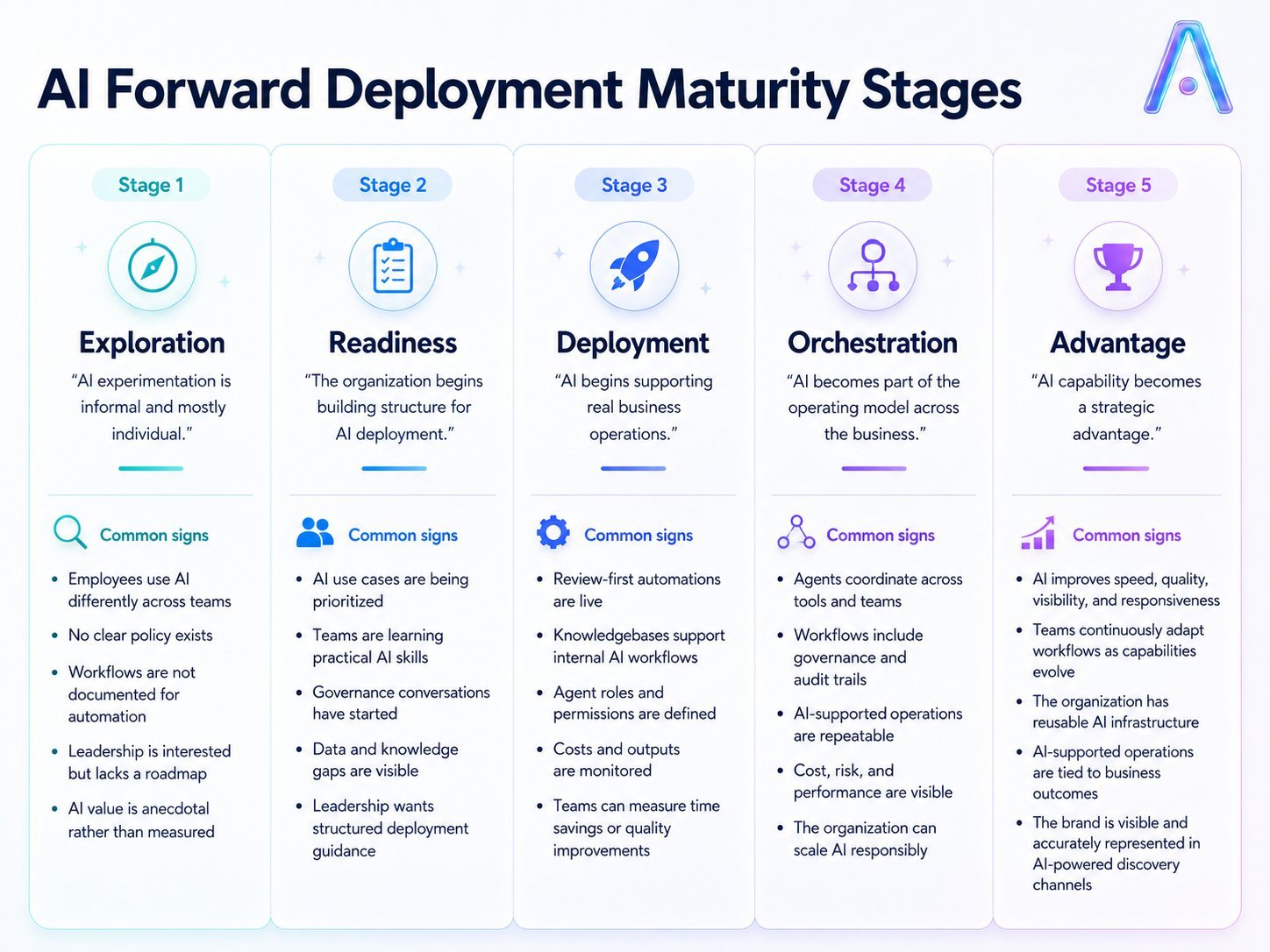
The signals you're at each stage.
Every stage has telltale signs. Match yours below.
AI experimentation is informal and mostly individual. Leaders are curious but there's no shared playbook.
The organization is building structure for AI deployment — prioritizing use cases, training teams, mapping gaps.
AI begins supporting real business operations. Workflows, agents, and knowledgebases are live and measured.
AI becomes part of the operating model across the business. Agents coordinate across tools and teams.
AI capability becomes a strategic advantage. The brand is visible and accurately represented in AI-powered discovery.
Where is your organization blocked?
Most AI deployment challenges fall into one of eight categories. The symptom tells you which pillar to start with.
People are using AI, but there's no shared strategy.
Teams use different tools, different prompts, no governance, no shared goals.
You need AI literacy, leadership alignment, and an adaptive learning environment.
Workflows are too manual or unclear for automation.
Smart people doing repetitive work. Process steps undocumented. Bottlenecks tribal.
You need operational mapping and process redesign.
AI tools are scattered across the company.
ChatGPT in marketing, Claude in product, agents in sales — none talking to each other.
You need an orchestration layer and agent operating model.
Your tech stack is disconnected or hard to integrate.
Tools don't talk to each other. Source-of-truth is contested. APIs missing.
You need modernization, system mapping, and connector planning.
Your data and documents are messy.
Knowledge scattered. Outdated SOPs. Agents would hallucinate because the source itself is unreliable.
You need source-of-truth mapping and agent-ready knowledgebases.
Security, privacy, and approval rules are unclear.
No AI usage policy. No approval gates. No audit logs. Exposure compounding silently.
You need practical governance and risk controls.
You don't know what AI usage will cost at scale.
Bills creeping up. Agent loops eating tokens. No model selection discipline.
You need LLM cost modeling and usage governance.
Your brand isn't showing up clearly in AI-generated answers.
ChatGPT can't describe what you do. Perplexity recommends competitors. AI Overviews skip you.
You need AEO visibility analysis and content strategy.
From AI curiosity to AI capability.
Each deliverable maps to one or more pillars. Start with the audit, then layer in the rest.
AI Readiness & Opportunity Mapping
Workflow inventory, stakeholder interviews, data audit, governance review. Prioritized roadmap by business impact.
Agent Operating Model & Workflows
Agent roles, permissions, orchestration logic, automation strategy, reusable workflow templates — designed and deployed.
Tech Stack, Integrations & Knowledgebases
System mapping, MCP and API readiness, agent-ready knowledge architecture, retrieval workflows that give AI the right context.
Governance, Security & Cost Controls
Acceptable use policies, role-based access, approval workflows, vendor risk review, LLM cost modeling, usage budgets.
AEO Visibility & Answer Engine Strategy
Brand mention tracking across AI engines, entity clarity, content structure, ongoing monitoring as AI search behavior evolves.
Training & Enablement
Practical AI training tied to real workflows. Live, virtual, or hybrid. Built for teams, leaders, and operators.
Pick your starting point.
AI adoption doesn't need to be chaotic. With the right framework, your organization can move from scattered tools to practical, governed, measurable AI operations.
AI Opportunity Report
Identify your highest-impact AI use cases, deployment gaps, and next best steps. A focused diagnostic across all 8 pillars.
AI Readiness Audit
Evaluate your workflows, systems, data, governance, and growth visibility across the full AI Forward Framework. 5-7 business days.
About the framework.
What is the AI Forward Framework?
A practical deployment model for organizations moving from AI experimentation to AI-enabled operations. It covers eight pillars (Mindset, Operations, Agent OS, Tech Stack, Data, Governance, Cost, AEO) and maps to five maturity stages (Exploration, Readiness, Deployment, Orchestration, Advantage). It's open methodology — free to cite, share, and adapt.
How is this different from other AI adoption frameworks?
Most AI adoption frameworks were built for enterprise governance — multi-quarter timelines, steering committees, seven-figure budgets. The AI Forward Framework is built for operators. The pillars are operationally specific and the maturity stages give organizations a clear way to locate themselves. It works at SMB scale without losing the rigor mid-market and enterprise teams need.
Do I need to implement all 8 pillars at once?
No. The framework is designed so each pillar can stand alone — but they compound when implemented together. Most teams start with one or two pillars (usually Operations and Governance, or Operations and Data) and add the others as readiness grows. The diagnostic above tells you which pillar to prioritize first.
How long does it take to move through the maturity stages?
Stage 1 (Exploration) to Stage 2 (Readiness) typically takes 30-90 days with focused effort. Stage 2 to Stage 3 (Deployment) takes 60-180 days. Stage 3 to Stage 4 (Orchestration) takes 6-18 months. Stage 5 (Advantage) is ongoing — it's a posture, not a destination.
Is the framework only for tech companies?
No. The pillars apply to any organization deploying AI — services firms, healthcare, education, nonprofits, manufacturing, real estate, retail. The specific implementation differs by industry, but the structure (mindset, operations, orchestration, stack, data, governance, cost, visibility) is universal.
Where does the Agent Operating System fit in?
The Agent OS is Pillar 3 — but architecturally it's also the connective layer that operates between the other pillars and the actual agent workforce. See the architecture diagram above. The framework prepares the organization; the Agent OS executes within it.
Can I use this framework without working with AI ARMY?
Yes. The framework is open methodology. The eight pillars, five maturity stages, and diagnostic are free to use, cite, and adapt. AI ARMY runs paid services that help organizations execute the framework — but the framework itself is not gated.